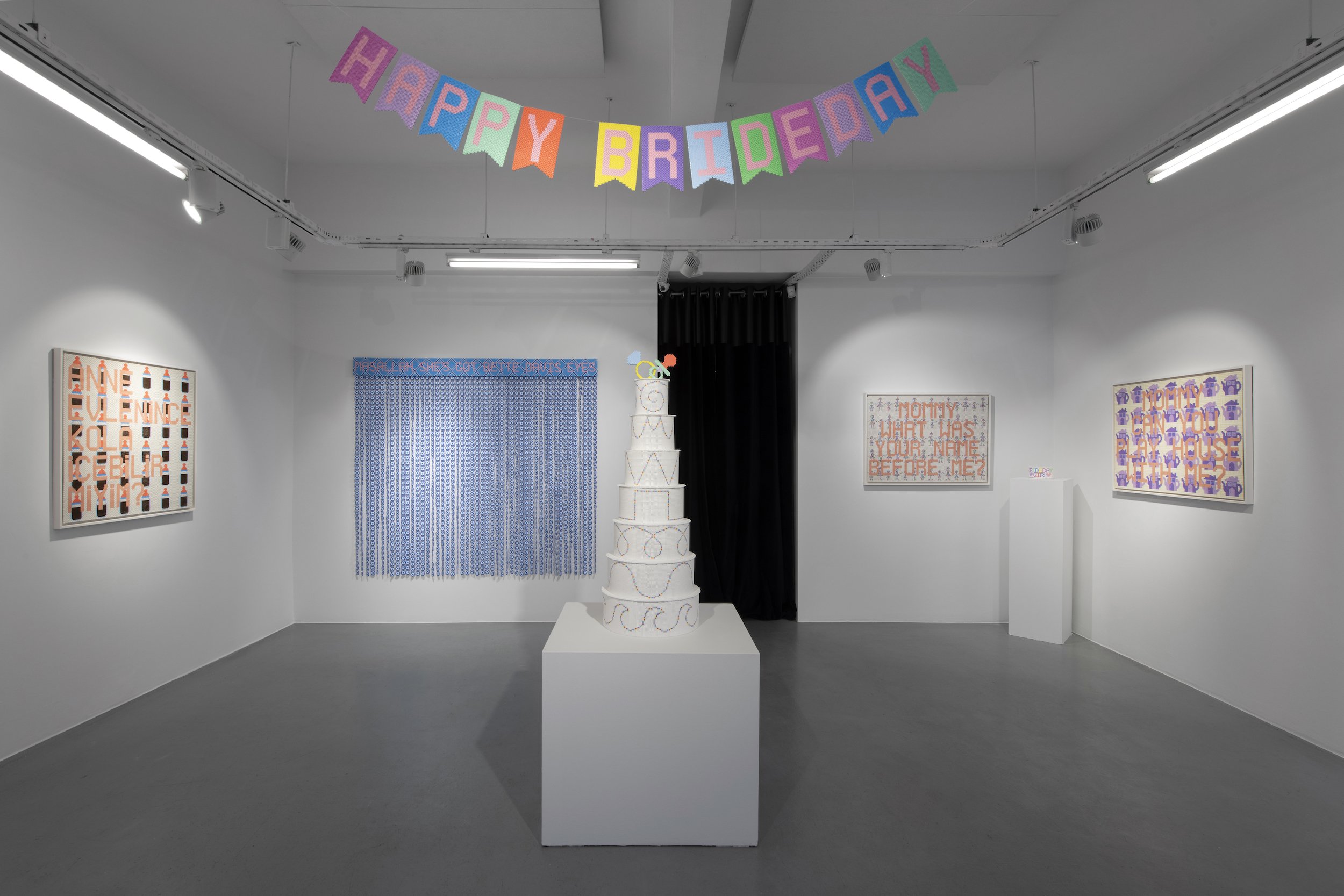
Girls is a series of fuse-bead text panels. Using a craft-coded material to bring together phrases drawn from the territories of girlhood and adult culture, the series examines how language participates in the erosion of boundaries between a female child and an adult woman. Words move freely between a daughter’s bedroom and a strip club, between a childhood game and a pornographic category.
Each panel is built from fuse beads in a palette inspired by teen makeup: nude, bubblegum, hot pink, and cherry red. The uneven melting created through ironing gives the beads a velvety texture, while leaving almost scar-like wounds across the surface.
Drawing on my experience coming of age in New York City in the 2000s, the series reflects on how permeable the boundaries of protection around girls have always been. The series is ongoing.
2026, fuse beads, 98 × 98 cm
GIRLS GIRLS GIRLS is the first work in the series. The phrase directly appropriates the most common strip-club sign, as well as the title of a Mötley Crüe song about strippers. The word “girls,” which names a child, shifts meaning when stacked and repeated three times.
2026, fuse beads, 98 × 98 cm
BREAST FRIENDS FOREVER replaces “best” in “BFF” with “breast.” This single word swap shifts the language of girlhood friendship toward the moment when puberty makes the female body visible and the male gaze enters the frame.
2026, fuse beads, 98 × 98 cm
TRUTH OR BARELY LEGAL combines the childhood game “Truth or Dare” with Barely Legal, a pornographic magazine built around the fantasy of youth and the sexualization of underage girls.
2026, fuse beads, 98 × 98 cm
WHO’S YOUR DADDY’S GIRL collapses “daddy’s girl,” an endearment for a beloved daughter, into “who’s your daddy?,” a phrase borrowed from pornography.
2026, fuse beads, 98 × 98 cm
POWERPUFF GIRLS GONE WILD places a cartoon centered on girl empowerment beside a reality franchise built around the sexualization of teenage girls. Both occupied the same television screen during my childhood.
2026, fuse beads, 98 × 98 cm
PIZZA DELIVERY ROOM joins “pizza,” a favorite childhood food, with “delivery room,” the site of birth. Placed together, these two seemingly innocuous phrases take on the coded vocabulary developed within online cultures around the trafficking of children.
2026, fuse-bead covers, 11 monotype acrylic prints on handmade Awagami Factory Kozo paper, 22 × 16 × 1.5 cm, Edition of 10 + 2AP
Girls is an artist book that examines how “girls,” a word meaning a female child, is recoded through culture. It looks not only at the word itself, but at the visual language attached to girlhood: how it appears in girls’ bedrooms, consumer products, and adult entertainment.
The book contains five pairs of found images printed in acrylic paint on handmade Japanese paper. In each spread, a strip-club sign appears on the left, while girls’ bedroom décor appears on the right. The pairings work through repeated language: “Live Girls” beside “you’re like really pretty,” “Baby Dolls” beside “Baby Girl,” “XXX” beside “xoxo.” Printed in the same pink monochrome, the two sources become formally indistinguishable.
The book’s small scale recalls a diary. Its fuse-bead cover places it within the register of children’s craft. Girls was shown as part of the project SLEEPOVER at the 2026 border_less Artbook Fair at SALT Galata, Istanbul, where it received the Best Table Award.
Mommy? is a series of fuse-bead text panels that uses the same plastic craft beads children use to make keychains and coasters to create large-scale works about motherhood, identity, and artistic practice. Each piece is made by placing beads by hand and fusing them with an iron, turning a domestic task into part of the artwork itself. The surfaces hold traces of heat, pressure, and the human hand.
The series began while I was playing with my children and their fuse beads. My daughter looked up and asked, “Mommy, did you used to be an artist?” The question became both the starting point of the series and my way back into my practice.
Each piece is made of approximately 30,000 beads and renders a question my children have asked. The early works stayed close to motherhood and the shifting boundaries of selfhood: “Mommy, what was your name as a kid?” “Mommy, can you wipe my butt?” As my children grew, their questions turned outward, opening onto wider cultural and political concerns.
2024, fuse beads, 70.5 × 97 cm
2024, fuse beads, 70.5 × 97 cm
.
2024, fuse beads, 70.5 × 97 cm
2024, fuse beads, 70.5 × 97 cm
2024, fuse beads, 70.5 × 97 cm
2024, fuse beads, 70.5 × 97 cm
2024, fuse beads, 70.5 × 97 cm
2024, fuse beads, 70.5 × 97 cm
2024, fuse beads, 70.5 × 97 cm
2025, fuse beads, 70 × 97 cm
2025, fuse beads, 70.5 × 97 cm
2025, fuse beads
70 × 97 cm
2024, fuse beads
70.5 x 97 cm
2025, fuse beads
70 × 97 cm
2025, fuse beads
70 × 97 cm
2023, fuse beads, 70 x 97 cm
2023, fuse beads, 70.5 x 97 cm
2023, fuse beads, 70.5 × 95 cm
2023, fuse beads, 70.5 x 97 cm
2023, fuse beads, 70.5 x 97 cm
2023, fuse beads, 70.5 x 97 cm
2023, fuse beads, 70.5 x 97 cm
2024, fuse beads, 58 x 87cm
2025, fuse beads, 70 × 97 cm
2025, fuse beads, 71 × 106 cm
2025, fuse baeds, 70 × 97 cm
2024, fuse beads, 70 × 97 cm
2024, monotype, acrylic on archival paper, 50 × 35 cm each. Ongoing.
Immaculate Conception rereads the Virgin Mary’s sinless conception through prints that merge biology and symbol. At first glance, the images appear to depict ovulation. On closer inspection, the “sperm” are tampon prints and the “eggs” are impressions of my breasts. The series uses parthenogenesis as a metaphor for creating art from the self.
2024, monotype, acrylic on archival paper, 50 x 35 cm
2024, monotype, acrylic on archival paper, 50 x 35 cm
2024, monotype, acrylic on archival paper, 50 x 35 cm
2024, monotype, acrylic on archival paper, 50 x 35 cm
2024, monotype, acrylic on archival paper, 50 x 35 cm
2024, monotype, acrylic on archival paper, 50 x 35 cm
2024, monotype, acrylic on archival paper, 50 x 35 cm
2024, monotype, acrylic on archival paper, 50 x 35 cm
2024, monotype, acrylic on archival paper, 50 x 35 cm each
2017–2019, clay and tea on canvas, 70 × 100 cm. Ongoing.
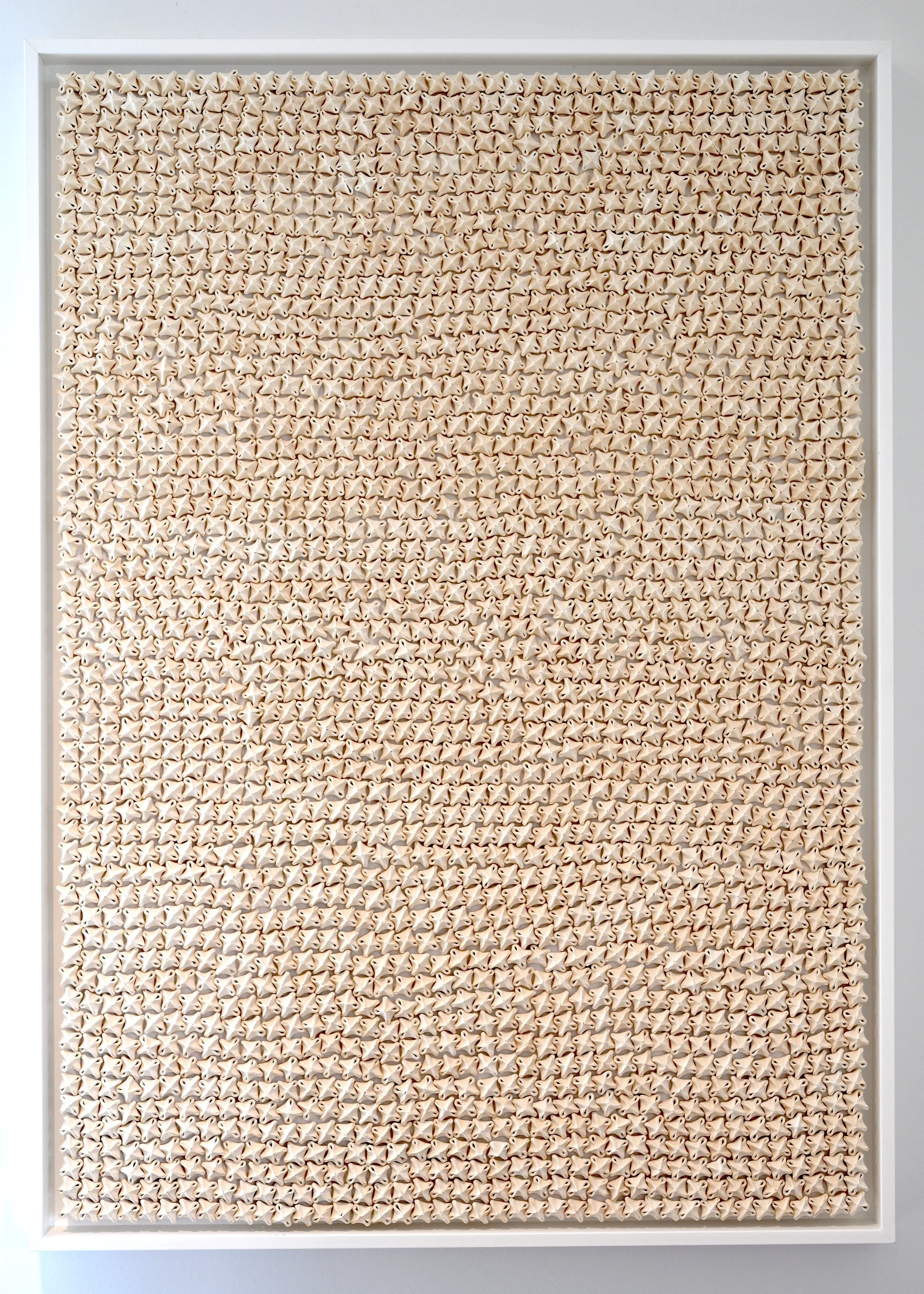
Ana-Dolu marks my return to art, made while I was pregnant with my second child in 2017. The title is a play on words: Anadolu, Turkish for Anatolia—the region often called the cradle of civilization—and ana dolu, “mother-filled.” The piece sits between my New York artist past and my Turkish wife-and-mother present.
The work centers on mantı, a traditional dish that takes hours to make and is eaten in an instant. In Kayseri, mantı is tied to marriage and used to judge a bride-to-be. By recreating it in clay, I render it empty and inedible. Shaping the clay mantı becomes a private protest against the labor traditionally assigned to women.
2024, clock, clay and tea, 29 cm, edition of 3 + 1 AP
The title combines mantı, mantıksız (“illogical”), and tıksız (“not working”). The work continues the metaphor of Ana-Dolu and expands it into a reflection on time and labor. Filled with clay mantı, the clock marks the invisible hours hidden within housework.